
Proximity-based check-in
An admin guide is also available. See: Proximity-based check-in guide for admins
Requirements for automatic check-in (proximity-based)
The following is required for a successful automatic check-in:
- The booking must be for a personal space that is a place to work – desk, office, etc. (Other workspace types, such as lockers and parking spaces, do not automatically check in).
- Eptura Engage mobile app must be allowed to use your location when you reach the vicinity of the workplace - even if the app is closed. This lets your device's operating system (OS) deliver an 'arrival' signal even when the app is closed - it does not mean Eptura Engage is watching your location in the background.
- The booking must be in the ‘check-in’ state when you reach the vicinity (about 250 meters) of the workplace.
- Automatic check-in is triggered when you are approximately 250 meters from the workplace.
Proximity-based check-in is dependent on many settings and considerations, and certain factors can prevent a successful automatic check-in.
How does Eptura Engage detect arrival?
When you create a booking, Eptura Engage registers the booked location's coordinates with your device's Android or iOS operating system and requests to receive a signal when your device enters that location on the booking date. The operating system sends an 'arrived' signal to Eptura Engage when you are approximately 250 meters from the workplace. When Eptura Engage receives the signal, your booking is checked in.
Eptura Engage only ever receives that arrival signal - not your coordinates, your movements, or any location history!
Permissions required by the Eptura Engage mobile app
Automatic check-in relies on your device's operating system (Android or iOS) sending an 'arrived' signal to Eptura Engage when you near the workplace.
Eptura Engage only ever receives that arrival signal - not your coordinates, your movements, or any location history
Because the operating system (OS) only shares this information with apps that have location permissions granted, you must allow the Eptura Engage mobile app to use your location even when it is not open - this allows the arrival signal to be sent when the app is closed - it does not mean Eptura Engage is watching your location in the background.
The mobile device must also have GPS and Location services turned on.
Setting the location permissions when opening the app
When you open the Eptura Engage mobile app for the first time (or after the device has been updated or restarted), you are asked if you want to enable Automatic check-in.
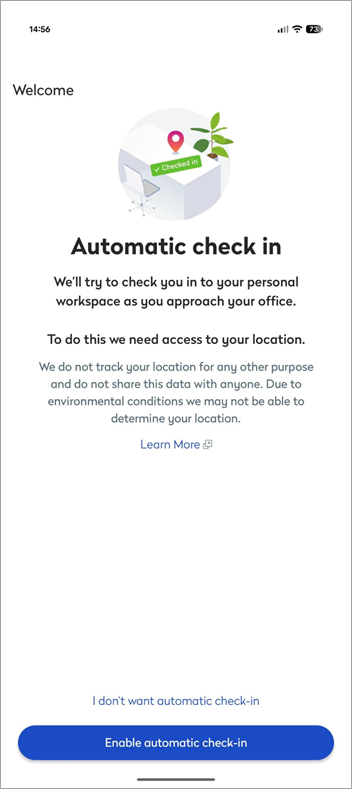
If you enable automatic check-in, you will then be asked to allow Eptura Engage to use Location services. Follow the steps below for your device.
iOS
- Tap Allow While Using App (this must be subsequently changed to 'Always allow').
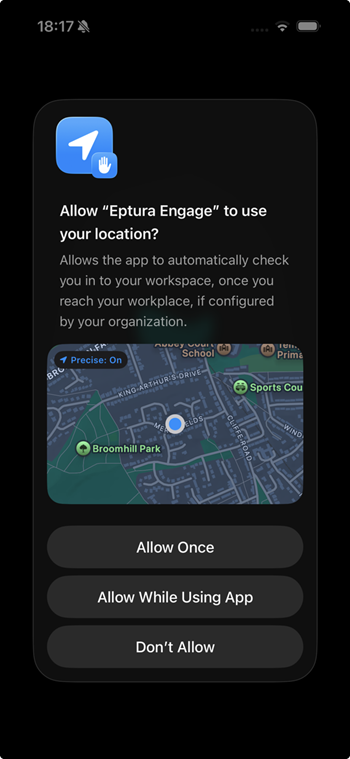
- After a few moments, the iOS system might present an option to Change to Always Allow - if so, you can set the option here. This lets your device's operating system deliver an 'arrival' signal even when the app is closed - it does not mean Eptura Engage is watching your location in the background.
- If the option 'Change to Always Allow' did not appear, change the setting to Always allow in Settings (see below).
Android
- Tap Settings to open the Eptura Engage app settings.
- Tap Permissions > Location, then tap Allow all the time. This lets your device's operating system deliver an 'arrival' signal even when the app is closed - it does not mean Eptura Engage is watching your location in the background.

How to allow the Eptura Engage mobile app location access
If you were unable to set the required location access when launching the Eptura Engage Mobile app, you can set it from the Location settings on your device.
To ensure your automatic check-ins via proximity are successful, go to the device settings and allow the Eptura Engage mobile app to use Location services all the time, not just when the app is open. This lets your device's operating system deliver an 'arrival' signal even when the app is closed - it does not mean Eptura Engage is watching your location in the background.
Follow the steps below for your device.
How to change location settings on an iOS device
- Open Settings on the iOS device.
- Enter ‘Eptura Engage’ in the search box.
- Select Eptura Engage.
- Set the Location access to Always. This lets your device's operating system deliver an 'arrival' signal even when the app is closed - it does not mean Eptura Engage is watching your location in the background.
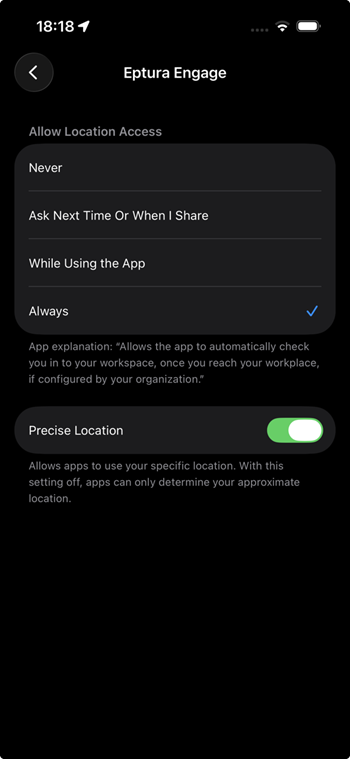
iOS - Location settings for Eptura Engage
- Set the Location access to Always. This lets your device's operating system deliver an 'arrival' signal even when the app is closed - it does not mean Eptura Engage is watching your location in the background.
How to change location settings on an Android device
- Open Settings on the Android device.
- Enter ‘Eptura Engage’ in the search box.
- Tap Eptura Engage when it appears in the search results.
- Tap Permissions.
- Tap Location.
- Tap Allow all the time. This lets your device's operating system deliver an 'arrival' signal even when the app is closed - it does not mean Eptura Engage is watching your location in the background.

Android - location settings for Eptura Engage
- Tap Allow all the time. This lets your device's operating system deliver an 'arrival' signal even when the app is closed - it does not mean Eptura Engage is watching your location in the background.
Factors affecting automatic check-in via proximity
The following factors prevent proximity-based check-in from triggering:
- Location permission is denied.
- Location permission is only allowed while using the app. If the app is closed when you arrive at the workplace, the device's operating system cannot send the 'arrived' signal to Eptura Engage.
- GPS is not enabled.
- Location services are disabled.
- Limited internet connectivity when arriving at the workplace, such as when entering through a basement, might prevent the operating system from sending the arrival signal.
Automatic check-in is not possible in the following scenarios:
- Bookings for personal spaces that are not set as a workspace (i.e., lockers, parking spaces, etc.) do not trigger automatic check-in.
- If a user does not self-certify before arriving at a location requiring self-certification, automatic check-in is not possible.
- If the user arrives before the allowed check-in time.
- If the mobile device does not have an internet connection.
- Meeting space bookings do not trigger proximity-based check-in.
Other considerations
More device-specific information is available: